Campaign
Campaign systems
SHOGUN 2 alternates a turn-based campaign on a map of Japan with real-time battles. Published descriptions of the 2011 campaign, which Complete Edition carries forward, center on economy, religion, agents, and a late crisis called Realm Divide. This page collects those documented systems. It is not a diary of play.
On this page
- Turns and battles
- Mastery of the Arts
- Religion
- Agents and diplomacy
- Realm Divide
- Field rules
- What is not documented here
How a campaign is structured
On the campaign, the player runs one clan: settlements, military production, the economy, and technology, then moves armies into battles that resolve in real time. Koku is the currency named in descriptions of the release. Generals and agents gain traits and abilities with experience, and clan management includes keeping family members loyal. Armies left on enemy land in winter, and fleets far from the coast, suffer attrition.
A Steam screenshot of the SHOGUN 2 setup screen, with Honma selected, prints a start year of 1545 and a short-campaign card. That card’s victory text says: become shogun by capturing and holding Kyoto; hold 25 provinces, including Sado and Kyoto; finish by the end of the turn in winter 1575. The game-mode control in the shot reads Short Campaign. Other mode names are not legible as a list, so this page does not invent a long-campaign deadline.
Fall of the Samurai uses a different clock. Wikipedia says that expansion raised the turns per year from four to twenty-four because it covers 1864 to 1876. That comparison is the published evidence that the main campaign uses four turns in a year. Rise of the Samurai and Fall of the Samurai are separate campaigns, covered on three campaigns.
Mastery of the Arts
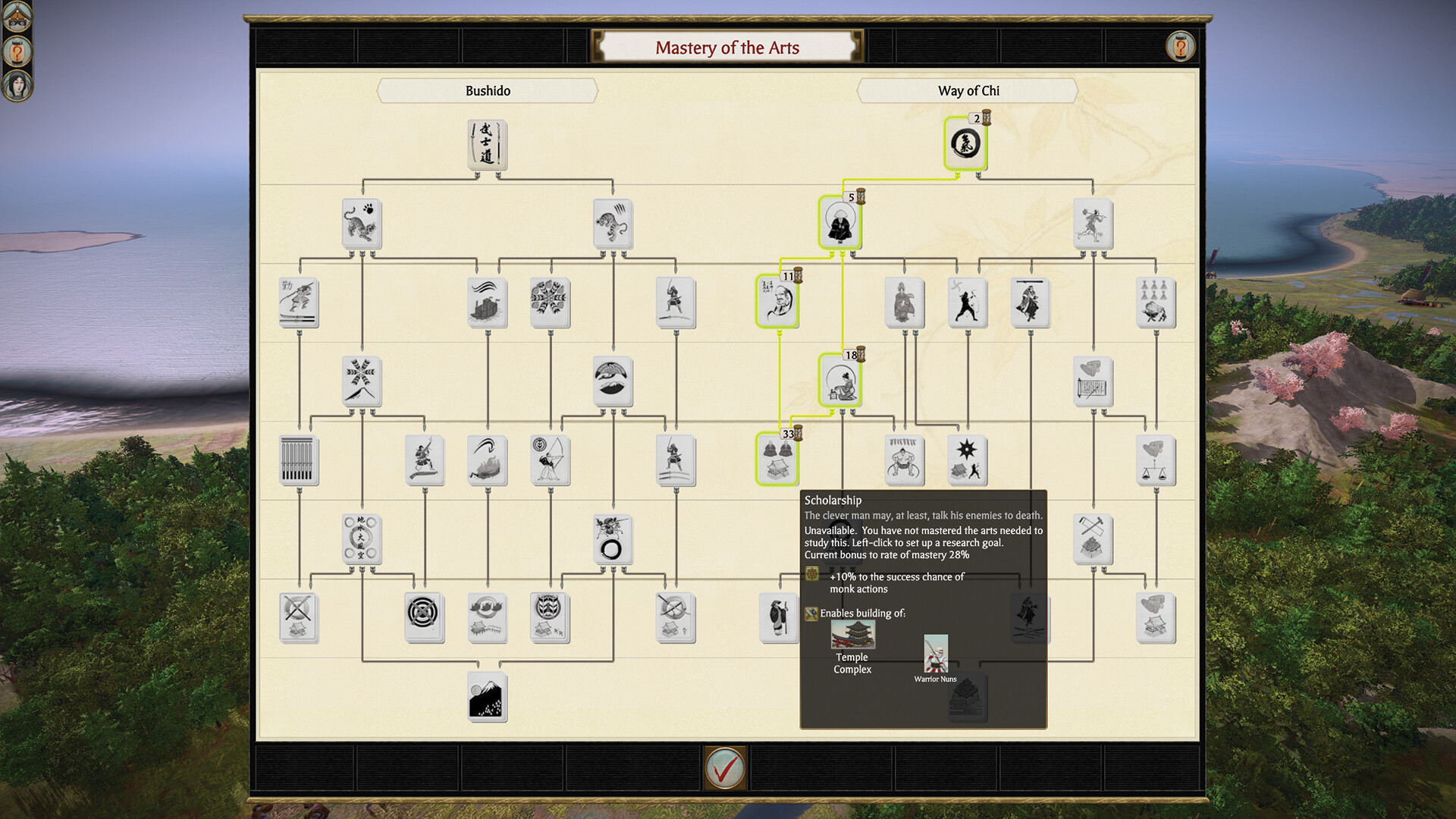
Research is a tree called Mastery of the Arts. Written descriptions divide it into Bushido, the military side, and the Way of Chi, covering economy, religion, and agents. The store screenshot of the screen uses those two headings. Arts unlock units, buildings, and abilities. Buildings, events, and character traits can speed research.
One node visible in the screenshot, Scholarship, is marked unavailable until earlier arts are mastered. The tooltip on that node cites a 28% bonus to research rate and a 10% bonus to monk actions, and it lists a temple complex and warrior monks among the buildings it enables. Those numbers are the tooltip’s, for that art, not a blanket research bonus.
Religion and public order
Most clans are described as Shinto-Buddhist. That faith supports warrior monks, infantry who trade armour for strong combat. Catholicism arrives with European trade and is tied to better trade and earlier firearms. Converting the clan to Christianity brings further advantages in those accounts. A province that does not follow the clan’s religion causes serious unrest. Religious buildings and agents are the documented counters. Spreading the clan’s faith into a rival province is described as a way to stir unrest there.
Otomo start Catholic. Uesugi are described as the Buddhist specialists, with stronger monks and more trade income. Ikko-ikki are the religious-rebel clan, with ronin and stronger warrior monks. Those identities are on the factions page.
Fall of the Samurai replaces this religious model with political allegiance: Imperial, Shogunate, or Republic. A province on a different allegiance takes a public-order penalty. That rule belongs to the 19th-century campaign, not to the Sengoku start.
Agents and the diplomacy screen
Four agent types are described for the main campaign.
- Ninja scout, sabotage, and assassinate.
- Geisha are described as assassins.
- Metsuke oversee provinces, can arrest or execute enemy agents, and can bribe armies or settlements.
- Monks, or missionaries for a Christian clan, inspire armies, spread religion, and push enemy agents to retire.
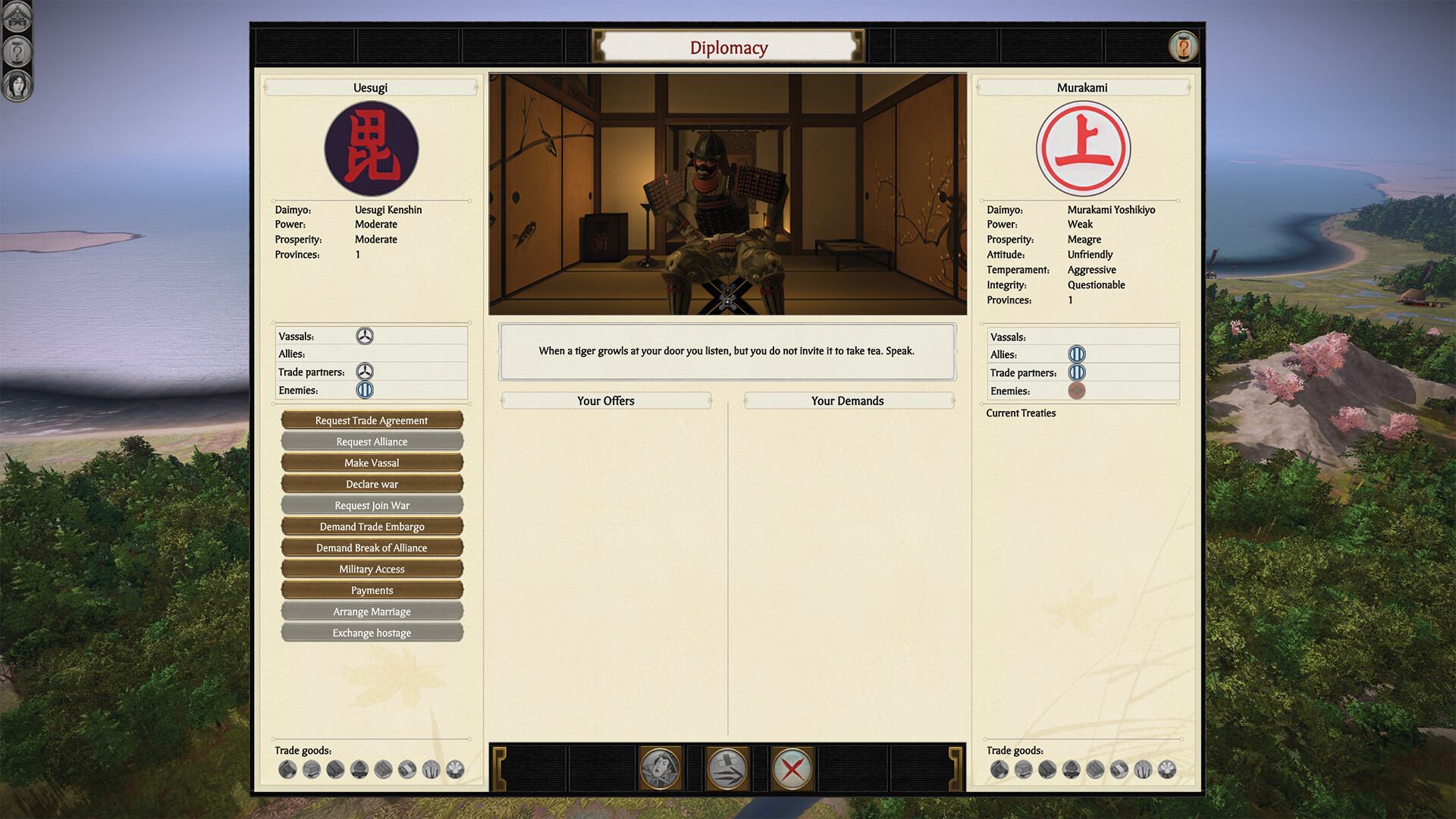
The diplomacy screen in that shot shows power, prosperity, attitude, temperament, integrity, and province count, plus vassals, allies, trade partners, and enemies. The actions printed on the panel are trade agreement, alliance, make vassal, declare war, request to join war, trade embargo, demand to break an alliance, military access, payments, arranged marriage, and exchange of hostage. Trade goods sit along the bottom. The pairing in the shot is one example, Uesugi and Murakami, not a scripted event this guide is treating as a required step.
Realm Divide
Realm Divide is the late rupture of the main campaign. Reference descriptions say it starts in either of two ways. One is taking Kyoto, the shogunate capital, and holding it for four turns, which makes the clan the new shogun. The other is raising clan fame to its maximum through conquered provinces and won battles. Surviving computer clans then declare war, generally one after another, and ally with each other. Allies are described as turning later than rivals. In a cooperative campaign the same crisis is described as hitting the human side.
The practical consequence of those rules is on the page because it follows from the triggers, not from a play session. Holding Kyoto starts a four-turn clock even if the player only wanted the city. Fame from a string of victories can start the same crisis while Kyoto still belongs to someone else. A campaign that is still stitching together trade and agents when fame peaks meets the war described above with whatever armies and treasury are already in place.
Rise of the Samurai keeps a Realm Divide event, according to Wikipedia’s description of that pack. Fall of the Samurai changes it: leading the Imperial or Shogunate cause sets the other side against the player and blocks war declarations on allies, while founding a republic leads to a gradual war with everyone else.
Battles, weather, forests, and sieges
Land battles are large meetings of armies that collided on the campaign map. Ashigaru are the basic infantry, cheaper and easier to recruit. Samurai need specific buildings, cost more, and fill specialist roles, including cavalry. Siege equipment in the written roster includes mangonels and European cannons. Kisho ninja are described as a stealth unit that climbs castle walls.
Japanese castles in these battles are multi-tier compounds. Accounts of the design contrast them with European wall fighting: more of the battle is in the courtyards. Weather matters. Fog cuts visibility. Heavy rain weakens missile troops, archers and gunners included, so a wet field changes the value of a ranged line.
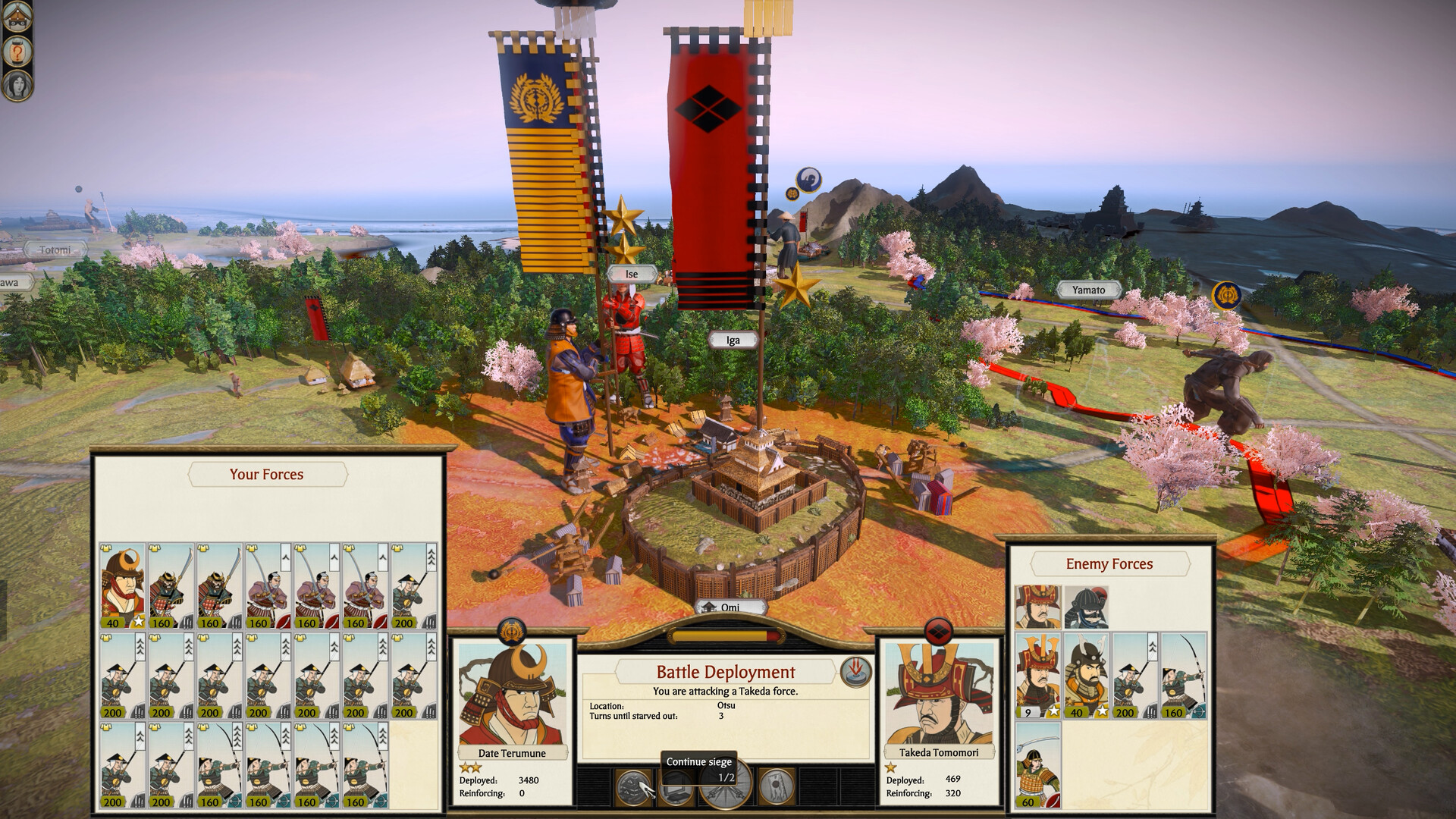
That starvation number is the value printed for this one deployment, a Date force of 3,480 against a Takeda force of 469. It is not a rule that every siege lasts three turns. The panel also offers “Continue siege” beside the option to fight.
A land-battle screenshot includes an on-screen line about forests: “Forests are highly effective at hiding units, but greatly reduce the combat ability and speed of cavalry units.” The same shot’s quick menu lists visibility settings, selection markers, movement paths, fire arcs, hiding foliage, occlusion outlines, and unit IDs. Those are interface switches shown in the image, not a settings manual.
Naval battles use Japanese warships that can shoot or board. A heavy bune card in another store screenshot calls that ship the mainstay of a fleet and says each one carries soldiers and bow-armed troops to attack enemy vessels. Fall of the Samurai later replaces this with steam warships and broadside guns, and it adds a manual aim view for artillery and ships. That later naval model is part of the 19th-century campaign.
What the Complete Edition sources do not say
The official FAQ does not describe balance changes, a rewritten Realm Divide, or a higher player cap for the campaign map. Steam’s store text confirms co-op and competitive campaigns and, separately, custom-battle lobbies of up to eight players. It does not say the campaign itself seats eight. Wikipedia’s account of the 2011 multiplayer campaign is two players. Until a patch note says otherwise, this guide treats the campaign player count as undocumented for the new edition and documented as two for the original.
Clan strengths that interact with these systems are on factions. Multiplayer modes and the mod break are on multiplayer and mods.